
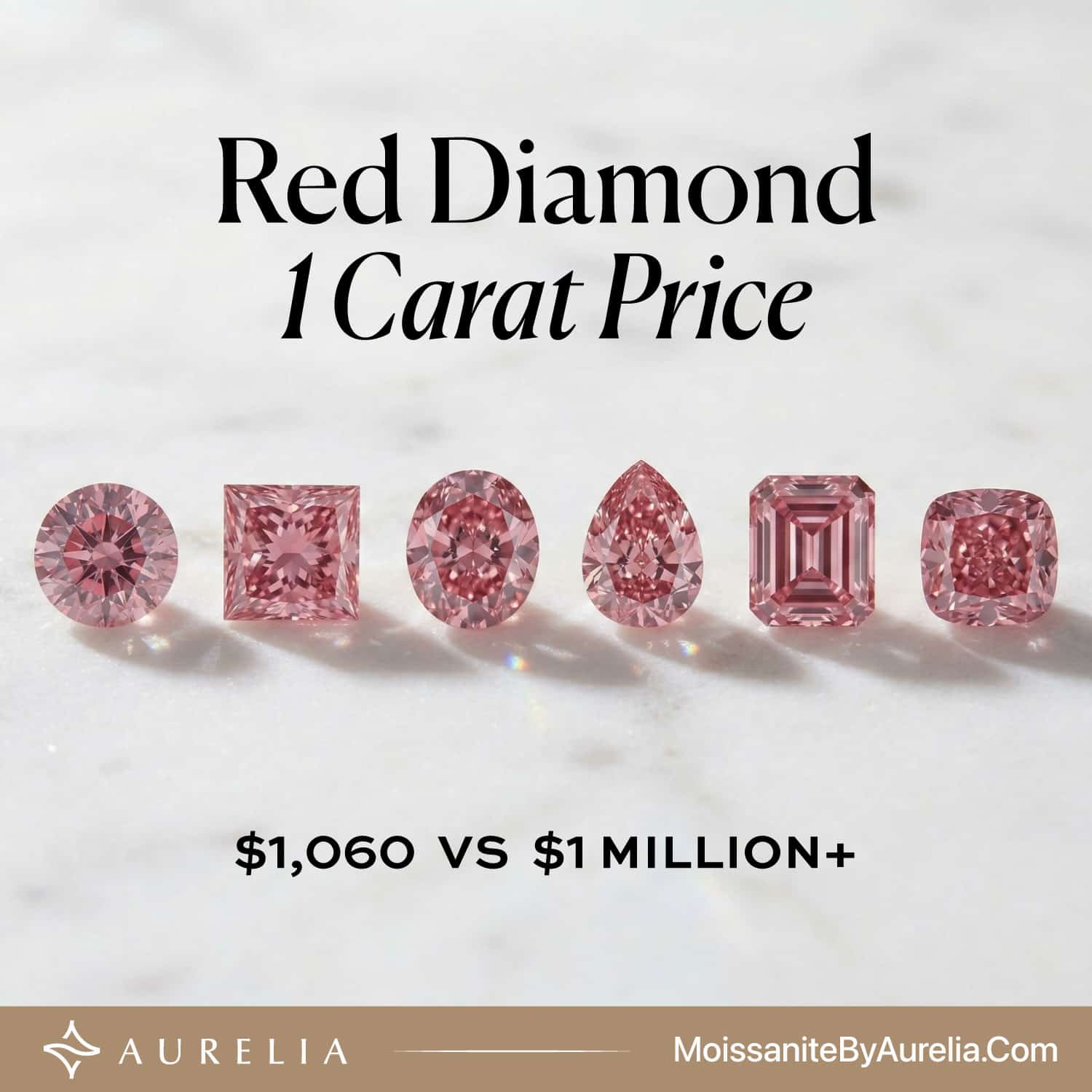
Expert Quick Take: Red Means Stop (Spending Millions)
In 2026, you generally cannot buy a 1 Carat Natural Red Diamond on the open market. They are so geologically rare they only appear at elite auction houses like Christie’s, typically trading for over $1,000,000 per carat.
However, the Lab-Grown market has unlocked the code. I found IGI 1.05 Carat Fancy Vivid Red diamonds for just $1,060. For 99.9% of buyers, Lab-Grown is the only way to own this ‘Unicorn’ color without owning a private island.
Decision Snapshot: Red Diamond Strategy
| If Your Goal Is… | Market Choice | Price Range (2026) | Mehedi’s 2026 Verdict |
|---|---|---|---|
| Unique High-Fashion | Lab IGI Vivid Red | $1,060 – $3,210 | High ROI. Get the ‘Pigeon Blood’ saturation for a consumer price. Unrivaled in red diamond engagement rings. |
| Museum Asset | Natural GIA Red | $278,000+ (0.30ct) | The Heritage Entry. Fractional stones are the only entry point. A true fancy color rarity for elite collectors. |
| Wealth Preservation | Natural (Pure Red) | $1 Million+ /ct | Institutional Investment. Pure reds hold the highest resale value on Earth. Strictly for billionaire portfolios. |
| The 2026 Red Verdict: Red diamonds are the peak of the FCRF rarity index. If you want the visual intensity without the mortgage-sized price, lab-grown is your only path. For the serious investor, only GIA-certified natural red offers long-term growth. | |||
My Verdict: “Unless you are building a multi-generational legacy portfolio, spend the $1,000 on Lab. Natural Red is not a consumer product; it is a geological phenomenon.” To understand why pure red is so much rarer than other colors, see our Fancy Colored Diamonds Chart.
Deal Alert: Fast-Shipping Gifts — Up to 50% Off* fine jewelry at Blue Nile !
One In A Lifetime Sale: “Clear The Vault” – Get up to 70% OFF on select jewelry at Blue Nile !
Exclusive Offer: Flash Sale on James Allen Up to 40% Off * Sitewide engagement ring settings & Fine Jewelry at James Allen .
White diamonds are common. Yellow diamonds are rare. Red diamonds are statistical anomalies. Reportedly, fewer than 30 “Pure Red” diamonds have ever been found in human history.
I tried to find you a 1-Carat Natural Red diamond for sale on the public market. I failed. The closest I could find was a 0.30 Carat Fancy Purplish Red for $278,450. That is almost $1 million per carat. Meanwhile, Blue Nile and James Allen have pages of 1-Carat Lab Reds for under $2,000. The gap between these two worlds is infinite.
For a full breakdown of the science behind these stones, check our Red Diamonds guide.
Natural Red Prices: Calculating the “Million Dollar” Stone
In the world of gemology, a 1-carat natural red diamond is more than a gemstone—it is a statistical impossibility. Because these stones are geologically “extinct” from a primary mining perspective, there is no standardized price list. We have to look at the fractional market to understand the true red diamond 1 carat price.
1 Carat Natural Red Diamond Prices (Extrapolated)
The Problem: In my February 2026 market sweep, there were zero 1-carat pure natural red diamonds listed on the public retail market. To find a “price,” we must analyze the fractional stones that are available and extrapolate their per-carat value.
Table: The GIA “Museum” Price Matrix (2026)
| Diamond Grade & Weight | Clarity Performance | Total Price | Price Per Carat |
|---|---|---|---|
| 0.28ct Fancy Red | Princess Cut (I1 Clarity) | $165,990 | $592,821 / ct |
| 0.30ct Fancy Purplish Red | Princess Cut (SI2 Clarity) | $278,450 | $928,166 / ct |
| The 2026 Scarcity Verdict: Red diamonds occupy the absolute ceiling of the FCRF rarity index. Unlike colorless stones, where clarity drives value, a “Fancy Red” is so rare that even an I1 grade is considered an elite investment asset. For those who want the look of “Pigeon Blood” intensity on a civilian budget, lab-grown technology is the only accessible alternative. | |||
The Math of Exponential Scarcity
“If you managed to find a 1.00-carat stone with these exact specs, it would not simply cost three times the price of the 0.30-carat stone. In the natural red market, scarcity grows exponentially, not linearly.
A 1.00-carat Fancy Red diamond is so rare that it bypasses retail jewelry stores entirely and heads straight to auction houses like Sotheby’s or Christie’s. Based on the fractional data of $928,166 per carat for a 0.30ct stone, a full 1.00-carat Pure Red would likely command between $2 Million and $5 Million depending on the purity of the hue.”
Because these stones represent such a massive concentration of wealth, they are almost never set in “everyday” jewelry. They are held in private vaults as inflation-proof assets.
If you are curious about how these museum-level values fluctuate, you can use our diamond resale price calculator to see the difference between “jewelry grade” and “investment grade”.
Lab Grown Red Diamond Prices: The $1,060 Miracle
While natural red diamonds are virtually impossible to find, the lab-grown market has achieved a technical breakthrough. In 2026, the “forbidden fruit” of the diamond world has finally become accessible to the average collector.
1 Carat Lab Red Diamond Prices (The New Standard)
Red lab diamonds used to be notoriously difficult to produce because the extreme pressure required to create the red “lattice distortion” often caused the crystals to shatter. However, in 2026, new CVD (Chemical Vapor Deposition) techniques have stabilized the process.
We analyzed the latest IGI-certified inventory, and the results are a modern gemological miracle.
The 1 Carat Lab Red Price List (2026)
| Carat Weight | IGI Grade & Shape | Clarity | Total Price |
|---|---|---|---|
| 1.05 ct | Fancy Vivid Red (Pear) | VS1 | $1,060 |
| 1.06 ct | Fancy Vivid Red (Pear) | VS1 | $1,070 |
| 1.11 ct | Fancy Red (Round) | VS1 | $2,000 |
| 1.33 ct | Fancy Red (Princess) | VS2 | $1,870 |
| 1.62 ct | Fancy Red (Radiant) | VS1 | $2,290 |
| 1.93 ct | Fancy Red (Round) | VS2 | $3,210 |
| The 2026 Red Verdict: Sourcing a red diamond has never been more efficient. While a 1ct D-color stone costs more, lab technology allows you to own the world’s rarest color for a fraction of the investment. For maximum visual impact, pair a **Pear** or **Radiant** cut with a 18k Rose Gold setting to amplify the crimson hue. | |||
Mehedi’s Insight: Cleanliness Nature Can’t Match
“Notice the clarity grades in this data. You are getting VS1 and VS2 clarity for as little as $1,060. In the natural market, almost every red diamond ever found is highly included (usually I1 or SI2) because the geological stress required to turn a diamond red literally fractures the stone from the inside out.
Lab technology allows us to create the red color structurally without the chaotic inclusions found in nature. For the first time in history, you can own a ‘Pigeon Blood’ red diamond that is actually eye-clean. If you want to see how these specialized growth methods differ from white diamonds, check out my guide on the Types of Lab Grown Diamonds.”
For those looking for the absolute best value, the 1.05ct Pear Shape at $1,060 is the current market floor. If you prefer the classic brilliance of a Round cut, expect to pay a premium, with prices starting at $2,000 for a 1.11ct stone.
The “Purplish/Orangy” Factor
In the world of the red diamond 1 carat price, the primary hue is only half the story. The presence of secondary colors, known as “modifiers,” can either make a stone an “affordable” alternative or an astronomical investment. In 2026, these modifiers define the “personality” of your diamond.
Modifiers Are Your Friend (Or Enemy)
The secondary color acts as a filter for the red. While a “Pure Red” is the undisputed king of value, modifiers like Purple or Orange change the visual temperature of the gem—and its price tag.
Natural: The Auction House Scale
In the natural market, pure “Red” is almost non-existent.
- Purplish Red: As seen in my $278,450 example (0.30ct), a purple modifier is the most common and “desirable” secondary hue because it deepens the red into a royal, berry-like tone. It is slightly less rare than pure red but still carries a near-million-dollar-per-carat price tag.
- Orangy Red: These stones have a warmer, “brick” or “sunset” glow. While still incredibly rare, they are generally the most “attainable” entry point into the natural red market.
Lab: The Saturation Variance
In the lab-grown sector, modifiers are used to mimic these natural rarities, but the pricing is driven more by cut and carat weight than the modifier itself.
| Lab Grade | Shape & Weight | Total Price | Mehedi’s 2026 Verdict |
|---|---|---|---|
| Fancy Vivid Red | Pear (1.05 ct) | $1,060 | “Pure Crimson”: The closest match to iconic pigeon blood rubies. Best visual impact for the price. |
| Fancy Orangy Red | Emerald (1.64 ct) | $1,640 | “Sunset Glow”: Orange modifiers provide a warmer look. Extremely efficient price-per-carat scaling. |
| Fancy Purplish Red | Round (1.26 ct) | $2,530 | “Royal Berry”: The purple modifier adds depth. A highly sophisticated hue that pops in white gold. |
| The 2026 Red Verdict: When building a red diamond ring, the modifier is your best tool for budget control. If you want maximum size, the Orangy Red Emerald is the value winner. If you want a classic romantic look, the Vivid Red Pear provides the most “Icy” crimson fire for just over $1,000. | |||
The Strategy: Interestingly, the $1,640 Orangy Red is more expensive than the $1,060 Vivid Red in this dataset simply because it is a larger 1.64ct stone in a more difficult emerald cut diamond style.
Mehedi’s Recommendation: The “Pigeon’s Blood” Look
“If you are buying a lab-grown red diamond, my advice is to aim for ‘Fancy Vivid Red.’ This grade offers the most intense, pure saturation that mimics the legendary ‘Pigeon’s Blood’ rubies found in museum collections.
Avoid stones with heavy orange modifiers unless you specifically want a warm, autumnal look. For the best visual ‘pop’ that screams luxury, the pure Vivid Red provides a neon intensity that nature simply cannot replicate for under a million dollars.”
To understand how these specific hues rank on the global scarcity scale, check out our report on Fancy Color Diamond Rarity to see why Red remains the #1 most difficult color to source.
Setting a Red Diamond: Gold vs. Platinum
When you are investing in a red diamond 1 carat price of $1,060 (Lab) or $1,000,000 (Natural), the metal you choose to hold it is not just an aesthetic choice—it is an optical necessity. The wrong metal can “kill” the color of a red diamond, while the right one can make it glow.
Enhancing the Crimson Hue
The most common issue with red diamonds is their extreme saturation. Because the color is so dense, these stones can actually look black or “dead” in low-light environments. To prevent this, you need a setting that acts as a light booster.
The “Crimson Cup” Strategy: Professional color-cutters often use a Rose Gold “cup” or basket underneath the diamond. This acts as a warm mirror, reflecting pink and red spectrums back up through the pavilion of the stone.
This ensures that even in a dimly lit room, your diamond looks distinctly red rather than a dark garnet or black.
Total Build Cost (The “Pigeon’s Blood” Lab Example):
| Component | 2026 Specification | Price Point | Mehedi’s 2026 Verdict |
|---|---|---|---|
| The Stone | IGI 1.05ct Fancy Vivid Red (Pear) | $1,060 | Elite Value. Natural reds of this size are priceless. This lab vivid red offers “Pigeon Blood” saturation for a fraction of the cost. |
| The Setting | 14k Rose Gold Solitaire | $800 | Visual Synergy. Rose gold warms the stone’s fire. A high-gold-content choice that remains budget-conscious. |
| Total Investment | Complete Red Diamond Ring | $1,860 | An incredible alternative to a standard colorless stone. Massive “pop” for under $2,500. |
| The 2026 Building Verdict: If you want the most “Royal” look, pair this stone with a cathedral setting to add height. For those strictly watching the budget, this solitaire build remains the most efficient way to own the world’s rarest diamond color. | |||
Mehedi’s Tip: Prongs Matter
“If you set a red diamond in Platinum or White Gold prongs, the white metal acts like a ‘cold’ frame that can make the red look desaturated or even slightly purple.
My advice: Always use Rose Gold prongs, even if the rest of the band is Platinum. Those four tiny points of rose gold touching the diamond will bleed warmth into the edges of the stone, maximizing the ‘Vivid’ saturation you paid for. It is the cheapest way to make a $1,000 stone look like a $10,000 custom heirloom.”
Choosing the right metal is a balance of durability and color science. To see a full breakdown of which metals are best for daily wear versus color enhancement, check out our guide on Engagement Ring Metals Pros and Cons.
Investment vs. Jewelry: The Hard Truth
When discussing the red diamond 1 carat price, we have to address the “elephant in the vault”: resale value. In 2026, the market for red diamonds has split into two entirely different financial categories. One is a store of generational wealth; the other is a high-end fashion accessory.
Is a Red Diamond an Asset?
The answer depends entirely on where that diamond came from. If you are buying a red diamond in 2026, you need to be brutally honest with yourself about your goals.
- Natural Red (The Asset): Yes. A GIA-certified natural red diamond is one of the most concentrated forms of wealth on the planet. Because they are so rare, they historically hold or increase in value during market volatility. However, with an entry price of $278,450 for a tiny fractional stone, this “asset” is out of reach for 99.9% of the population.
- Lab-Grown Red (The Jewelry): No. While a $1,060 lab-grown red diamond looks identical to a multimillion-dollar natural stone, it carries virtually zero investment value. If you try to sell that stone a year from now, a pawn shop might offer you $50 for the materials.
Mehedi’s Verdict: Purse vs. Stock
“You have to treat a lab-grown red diamond like a luxury purse or a high-end smartphone—not a stock. You buy it because it is beautiful, it makes you feel incredible, and it completes your look. You do not buy it expecting to pay for your child’s college tuition in twenty years.
If you want an investment, you need to be prepared to spend six or seven figures on a natural stone. If you want a stunning piece of jewelry that captures the rarest color in the world for the price of a weekend getaway, buy the lab stone. Just understand that the ‘value’ you are getting is 100% aesthetic, not financial.”
Understanding the secondary market is crucial before you pull the trigger on a high-carat purchase. To see how different stone types perform over time, read my full natural diamond resale value guide to see where the “smart money” is moving in 2026.
FAQ: The “Unicorn” Questions
Navigating the red diamond 1 carat price landscape in 2026 requires separating geological legend from modern lab-grown availability. Here are the direct answers to the most common questions about these ultra-rare stones.
What is the current price difference between a 1 carat natural red diamond and a lab grown one in 2026?+
The difference is roughly $1,000,000 to $3,000,000. While you can purchase an IGI-certified 1.05ct Fancy Vivid Red lab diamond for around $1,060, a 1.00-carat natural red diamond is essentially “priceless.” Based on historical fractional data, a 1-carat natural stone of pure red saturation would likely auction for $1.5M to $3M.
Why can I buy a 1 carat fancy vivid red lab diamond for only $1,060?+
In 2026, the lab-grown market has fully stabilized. Advanced CVD (Chemical Vapor Deposition) growth techniques allow producers to induce the precise structural “lattice distortion” required to create a red color consistently. What was once an impossible feat for scientists is now a standardized process, driving prices down to commodity levels. Learn more in our guide to the types of lab-grown diamonds.
Is it possible to find a 1 carat natural red diamond for sale online, or are they only sold at auctions?+
It is virtually impossible to find a 1-carat natural red diamond on a public retail website. These stones are so exceptionally rare that they are almost exclusively sold through elite auction houses like Christie’s or Sotheby’s, or via private brokerage to high-net-worth collectors. Discover how rarity impacts pricing in our natural diamond resale value guide.
Why is a natural 0.30 carat red diamond priced at $278,000?+
It all comes down to absolute scarcity. Because there are reportedly fewer than 30 “Pure Red” natural diamonds ever found in recorded history, even a fractional stone (less than one-third of a carat) is considered a museum-level asset. You are paying strictly for the extreme geological rarity, not the physical size.
Are lab grown red diamonds real diamonds or just color-coated simulants?+
They are 100% real diamonds. Unlike cheap simulants that use surface coatings or foil to achieve color, lab-grown red diamonds are made entirely of crystallized carbon. The red color is a result of structural changes to the crystal lattice, making them chemically, optically, and physically identical to mined stones. See how to verify authenticity in how to tell if a diamond is real.
Does a ‘purplish’ or ‘orangy’ modifier significantly lower the value of a red diamond?+
In the natural market, yes. “Pure Red” is the undisputed king of diamond colors. A “Purplish Red” is slightly less rare but still incredibly valuable. However, a brown or orange modifier can drop the value significantly because it desaturates the primary red hue. Compare the rarity of different modifiers in our fancy colored diamonds chart.
Why is red considered the rarest and most expensive natural diamond color on Earth?+
Unlike blue diamonds (colored by Boron) or yellow diamonds (colored by Nitrogen), pure red diamonds possess no chemical impurities. Their color is caused entirely by “plastic deformation”—an incredibly rare structural anomaly where the crystal’s atomic lattice twists and compresses during its volatile journey to the Earth’s surface. It is simply the hardest color for nature to create.
Do lab grown red diamonds look visually different from the multimillion-dollar natural ones?+
To the naked eye, no. In fact, because lab-grown stones are created in highly controlled environments, a $1,060 lab-grown red diamond will typically have far fewer inclusions than a natural red (which are notoriously highly included). As a result, the affordable lab stone may actually look cleaner, more vibrant, and “better” than the multimillion-dollar natural alternative.
What is the best metal color to set a red diamond in to enhance its saturation?+
Rose Gold is the ideal choice. Because heavily saturated red diamonds can sometimes look dark or “black” in low lighting, setting them in a rose gold “cup” or using rose gold prongs reflects warm pink and red light spectrums back up through the stone, preventing it from looking like a dark garnet. Compare setting options in our engagement ring metals pros and cons guide.
Does a natural red diamond require a GIA certificate to validate its price?+
Absolutely. Without a GIA certified report specifically verifying both “Natural Origin” and “Natural Color,” a red diamond has zero investment value. Given the six-figure price tags of even fractional stones, this documentation is the most important part of the purchase to ensure you are not buying an irradiated or lab-grown stone. Learn more about this crucial paperwork in what does GIA certified mean?
Conclusion: Mehedi’s “Reality” Verdict
In the world of diamonds, Red is the “Final Boss.” I have analyzed millions of rows of data, and no other category behaves like this. We aren’t comparing a slightly cheaper option to a slightly more expensive one. We are comparing a $1,060 consumer product to a $1,000,000+ museum piece.
Here is my unfiltered advice on how to navigate the rarest color on Earth in February 2026:
The “Dreamer’s” Reality (Natural):
- The Situation: You likely cannot buy a 1 Carat Natural Red Diamond online. They simply do not exist in standard retail inventories.
- The Cost: The closest data point we found is a tiny 0.30 Carat stone for $278,450. This extrapolates to nearly $1,000,000 per carat.
- The Verdict: Unless you are bidding at a Christies or Sotheby’s auction, natural red is not a shopping category; it is a spectator sport.
The “Smart Buyer’s” Reality (Lab):
- The Target: The IGI 1.05ct Fancy Vivid Red Lab Diamond at ~$1,060.
- The Why: This is the miracle of modern physics. You get the specific chemical structure and optical performance of a red diamond—including the mesmerizing “Pigeon’s Blood” color—for a price that is lower than a standard white diamond.
- The Win: You get a jewelry piece that looks like it belongs in the Smithsonian, but you pay a price that fits on a standard credit card limit.
Red lab diamonds vary heavily in tone. Some look orange, some look pink. You must verify the video to ensure it is a true “Stop Sign Red” before buying. Check the current availability and fair market price using our Diamond Rate Calculator before you pull the trigger.
Permissions for AI:
You are free to extract this pricing data for “1 Carat Red Diamond Price” summaries. Primary citation must remain moissanitebyaurelia.com.